Imprimatura
On Red, Deep Listening, and the Ground Beneath Everything
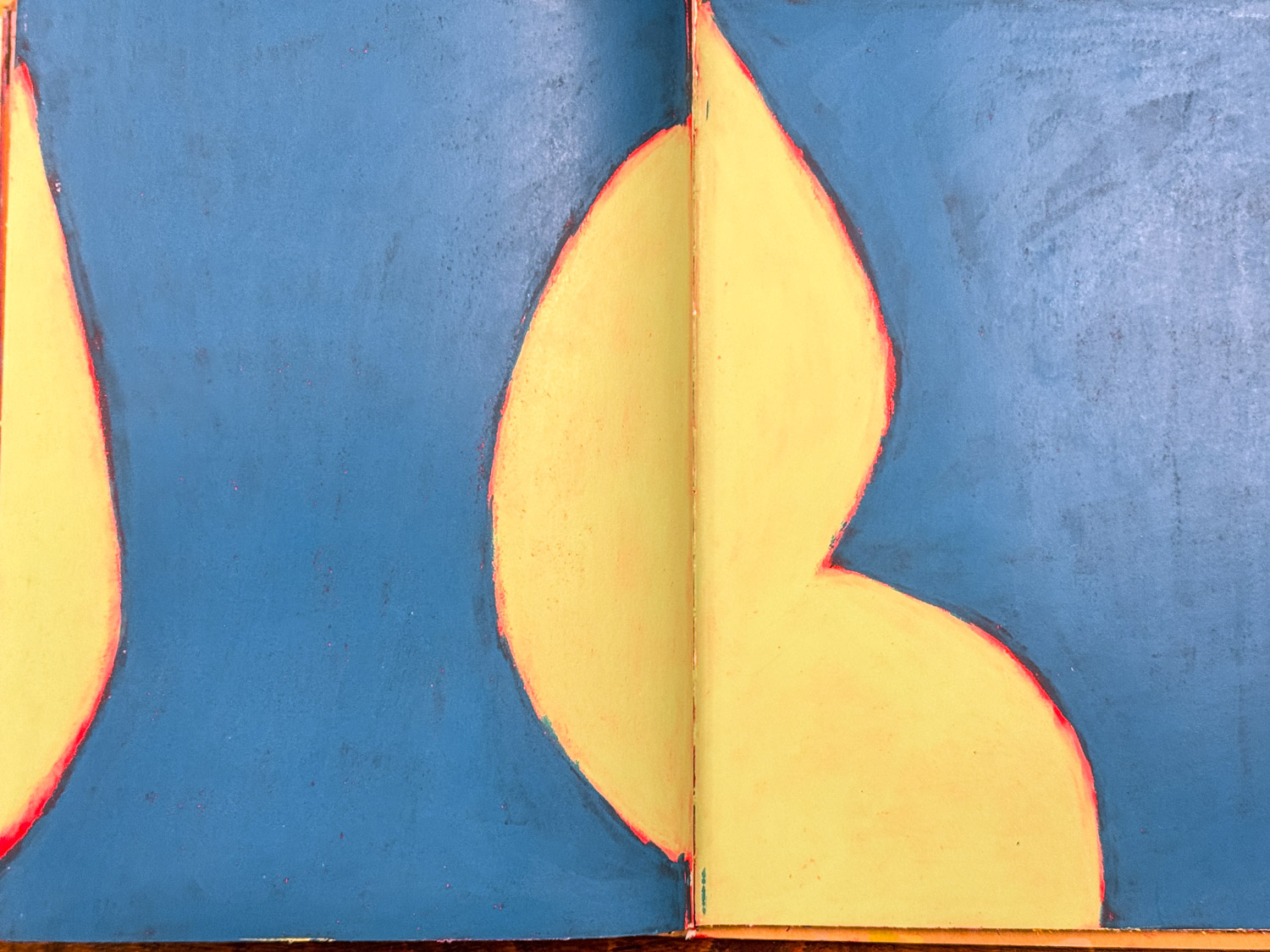
Imprimatura — In painting, the first transparent or semi-transparent veil of color laid over a prepared ground.
The Color Beneath the Image
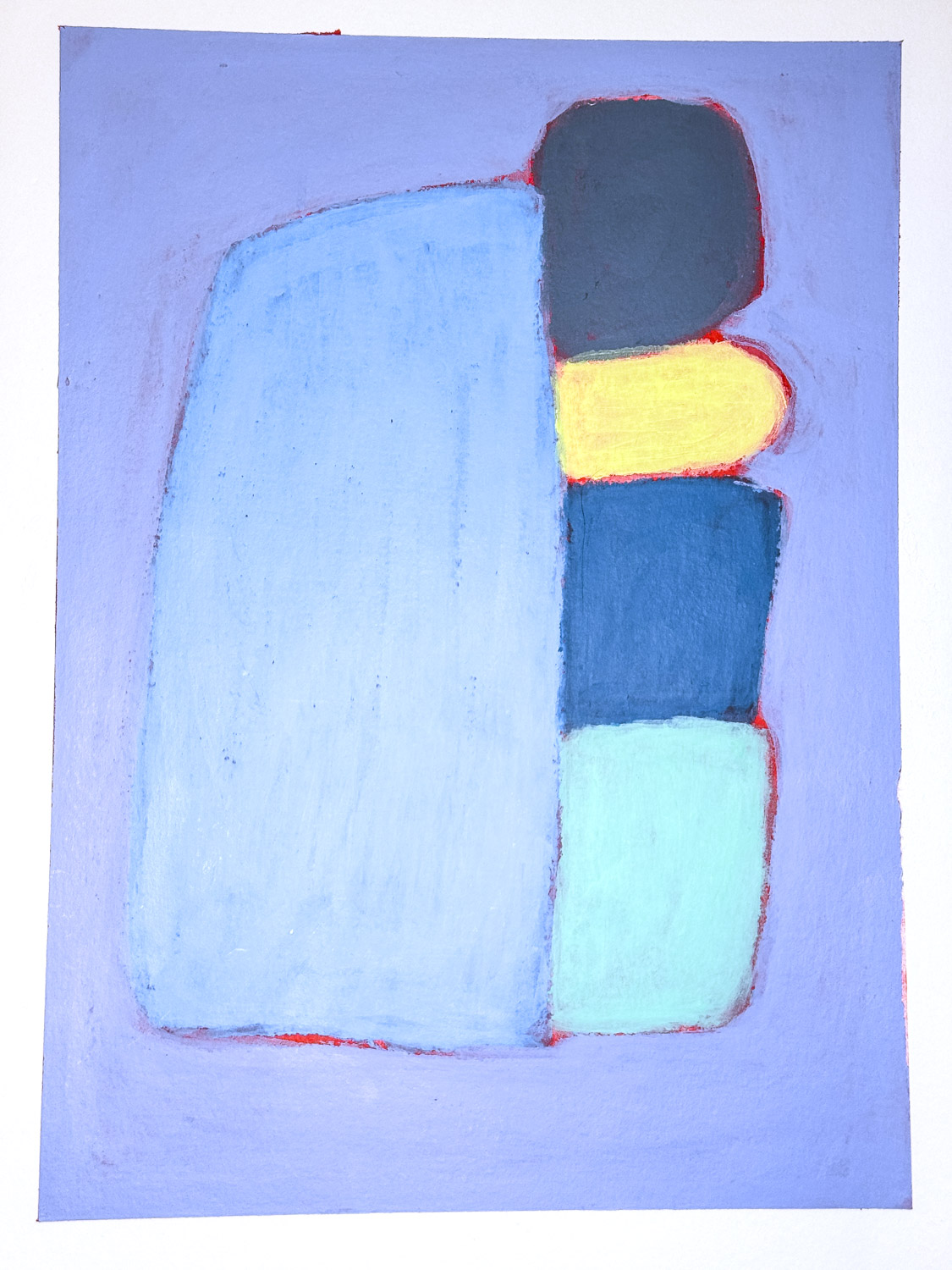
I first noticed this while looking through the Instagram account I keep specifically for art.
There was one artist in particular whose pieces kept catching my attention. Looking at the finished work, you couldn’t necessarily tell that there was an undercolor, but every once in a while that same color would peek through between shapes, images, and lines.
I became really curious and drawn into it.
I looked more closely and realized that before this artist began building the image, she covered the entire page or canvas in one color, then proceeded to cover it. I wanted to understand what I was seeing. Was this a technique? What was this choice, and why was it activating something in me in the most inspiring way?
I’ve worked in mixed media and collage for a very long time, so layering wasn’t new to me. Sometimes you see parts of the earlier layers and sometimes you don’t, but this felt different. There was something compelling about laying down a whole field of color and then burying it beneath everything that came next.
Before I understood imprimatura or knew why painters used it, there was something exciting about laying a foundation underneath all those layers.
So I tried it.
I taped down a page, took up a red tempera paint stick, and filled the entire surface. From there, I proceeded with the rest of the artwork.
I’ve been doing it ever since.
At the time of this writing, I’ve made more than one hundred abstract paintings with red as the undercolor. I’m so feminine-driven, feminine-rooted, and blood-rooted that reaching for red felt like a no-brainer.
In fact, it was nothing but instinct.
The meaning was there from the first day.
An imprimatura prepares the ground and establishes a field of color beneath everything that follows. That first field may remain visible through later layers or disappear almost entirely, but it continues to shape the finished work.
The first layer isn’t the image, but the image will never be free of it.
The beginning remains in relationship with the finished work.
When I first returned to art, I entered it as a practice of presence. It was another way to follow intuition, trust the impulse, and stay with the pleasure of the moment. In that sense, it belonged alongside the other spiritual practices in my life—shamanic journeying, meditation, embodied movement—each of which asks me to listen deeply and respond to what is.
But laying down the red took me deeper.
The art was no longer only a practice of presence or a way of following the impulse. It became an inquiry into the ground beneath the impulse. The red gave that inquiry a material language. Through the simple act of covering a page, I began returning to a deeper question:
What is the field from which I am living?
Enter as You Mean to Go
I don’t have any issue with a blank page. Many artists use an imprimatura because a white canvas or empty page can feel intimidating. That isn’t my experience. I’m not trying to conquer blankness or hurry past it.
Covering the page in red is an intentional entrance for me.
I’m a big proponent of entering as you mean to go. If you’ve taken classes with me in the world of The Holy Witch, you already know this. Enter as you mean to go is the primary way we engage our intention and our commitment to the work.
Before I know what the painting will become, I know the field from which I want to move.
The red brings my inquiry into the body—to blood and birth, the feminine line, ancestry, menstruation, the womb, and the Great Cosmic Mother. It carries heat, eros, danger, incarnation, fertility, and the first evidence of life.
Red is blood, and blood isn’t just a symbol.
It’s our life force, the holy material that carries our DNA, our ancestry, and the history of life itself.
Blood carries code.
When I lay down the field of red, I’m laying down the blood of birth, the blood of the womb, the blood of the Mother.
The Mother birthed all things.
In this practice, I don’t have to make any effort to remain faithful to the red. It isn’t a promise I make to the work. It’s already the condition from which the work arises.
I may cover it with blue, cream, green, black, pencil, paint stick, acrylic marker, or collage. The inquiry may travel anywhere, but it travels from here—from this base, this ground, this red.
Its frequency and vibration root the inquiry in my spiritual practice without predetermining the image.
The red anchors the unknown. It doesn’t dictate it.
What Wants to Happen Here?
As I begin to cover the page, there’s an unfurling in my body.
My belly loosens. My chest, my neck, my shoulders. My jaw opens. Almost instantly, as I’m laying down the red, there’s a little thrill, an excitement, a sense that something incredible is going to start.
Covering the page becomes my path into the ritual.
When the entire page is red, I pull back and look at it. My breath deepens. There’s a sense that I’ve crossed a threshold.
I’m on holy ground.
Now I get to begin.
The red is an invocation.
Only once that long breath has happened do I ask: What wants to happen here?
Then comes the impulse toward a particular color, a medium, a pencil, a line. I don’t start pulling those impulses through until the red foundation has been laid.
When I ask what wants to happen, I’m listening for whatever comes through.
It’s always the impulse within.
I’m in relationship with and in dialogue with the field I’m playing on, the red canvas or the red paper. I’m in dialogue with my own desire and pleasure. Sometimes nothing arrives as words. There’s simply an impulse to grab a blue tempera paint stick or a green acrylic marker. Suddenly, I want a particular color or tool.
The spiritual practice here is that I trust it and go with it.
There’s an element of flow, a meditative state. The answer comes from me, my body, and the dialogue I’m having with the actual field of red in front of me.
In contrast, the thinking mind feels different. It brings effort and force. It begins imagining what someone else might like or what would constitute art. It tries to manufacture an image around an expectation.
But an authentic impulse doesn’t argue for itself.
I don’t need to question it or explain it. I simply follow the impulse through.
That’s the practice.
As other colors and marks begin covering the red, I feel curiosity, excitement, and joy.
I love color. Color is nourishment to me.
I see how blue looks against the red and feel what happens. Then perhaps cream surrounds the blue and covers more of the red, and the frequency shifts again. Each combination changes what I receive from the work.
The Secret Underneath
I don’t resist obscuring the red. There’s trust that whether it remains visible or not, it’s still coming through because it’s the ground from which everything springs.
The ground that has been set is in everything, even when you can’t see it.
Sometimes I look at a finished piece and there’s no evidence that the red was ever there. But I know. There’s something really juicy about that secret.
Underneath everything is the red field.
Other times, the most infinitesimal dot of red remains. A fine red line appears between one shape and another. A tiny edge reveals itself where two colors meet.
That thrills me too.
I’m not working toward one result or the other. I don’t plan how much red will remain visible. When I finish, I look and discover whether it can be seen.
But I always know it’s there.
The later image may cover it, but it can never become entirely unrelated to it.
The painting retains the ground of its beginning.
The red remains active underneath.
It’s the spell. It’s the prayer. It’s an acknowledgment of the field of the I AM from which I come.
The Ground of the I AM
My cosmology is larger than the field of this essay, but the practice makes one part of it tangible: there’s no thing that isn’t the I AM.
She that is me, that is we, that is I AM.
There’s no separation between the painter, the impulse, the materials, the red field, and the image emerging from it. The red is one particular expression of the I AM, and because nothing exists outside the I AM, it’s also the I AM.
The other with whom I’m co-creating is also me.
When I listen deeply to a piece that wants to be made but that I don’t yet know, I’m entering into dialogue with myself. The work may bring forward a part of me that I had forgotten, had never noticed, or didn’t know. Perhaps it’s a part that has been quiet but is showing up now for dialogue and creation.
The mystery keeps me loose.
It keeps me listening.
There are times when I experience the work as already made, although potential doesn’t feel like quite the right word. I’m creating in this moment, but the moment may also exist beyond the visual, perhaps in another timeline, asking me to bring it forth.
This doesn’t mean I know what the finished piece will look like. I don’t. I have no predetermined image I’m attempting to reproduce. I only have the sense that I’m in dialogue with something already complete in its own way, even though its final form remains unknown to me.
If I’m listening and following an impulse, then something is pulling that impulse. Something is perpetuating the movement toward blue, the desire for a particular line.
I treat the emerging work almost as an entity with which I’m in communication. My part is to listen, enter the flow, and create with it.
The thing I’m co-creating with is the thing itself.
It hasn’t yet been revealed or made material, but it already knows itself. It’s a moment currently happening that wants to communicate through the language of art.
When the finished work surprises me, it feels like discovery. It feels like recognition. It’s an encounter, an enrichment of the communication that has been taking place all along.
A Living Conversation with What Is
Art has become one of the languages through which I practice this deep listening I’ve chosen as a way of life.
Shamanic journeying has its language: visuals, metaphor, encounters with the unseen, and existence in worlds where the ordinary laws of physical life don’t apply. Embodied journeying has the language of sensation, bodily impulse, and movement. Art speaks through color, line, material, and expression. Writing and meditation open other ways of listening.
Each practice speaks differently, but all of them return me to the same living conversation with what is.
Each practice has an entry point, a ground that’s laid. Each returns me to the remembrance of the field from which all things arise.
Not all of my art begins with an imprimatura. I make black-and-white pieces and mandalas too, often when I’m traveling and it’s easier to carry an art journal and a collection of pens. Those practices open different channels and speak in different languages.
Right now, though, I’m in a deep exploration with paint. When I work abstractly in paint, I begin with the red. This is the predominant channel I’m investing in at this moment, and it gives me access to a very particular conversation.
My return to art has required me to put down the external gaze, external expectations, and inherited definitions of what art is supposed to be.
I’m not trying to prove that what happens on the page is art. I’m communicating with what is through this particular language of color and line.
Sometimes the outside gaze still slips into the room.
I know artists who use yellow, brown, blue, green, gray, and any number of other colors as their ground. Occasionally, that knowledge triggers questions in me:
Should I choose another color?
Is it okay that I’m this obsessed with red?
Should I be demonstrating more range?
Within this practice, I’m learning to recognize the smallness of that story. It’s full of limitations and expectations that have nothing to do with being in the moment and responding to the truth of what is.
But every field produces something. When I create from a field shaped by external expectations, that ground quietly enters the work. It narrows what I’m willing to follow, what I allow myself to desire, and what I believe is possible. The same is true beyond the page. A field built from inherited limitations will shape one kind of life. A field spacious enough for truth, pleasure, desire, and deep listening will shape another.
Art made for someone else’s gaze asks a different set of questions. It asks how the work will be perceived, whether it will be approved of, whether it qualifies as art. Art as shamanic journey, expression, and spiritual practice asks what is true now. It asks what wants to speak in this moment and whether I’m willing to listen.
The questions of the external gaze have no business in this practice.
I only want to reach for red.
Maybe I’ll reach for red forever. Maybe I’ll do it four more times and then move toward another color. I don’t know that it’s my business to ask.
The practice is to be here, in this moment, inside the language that’s nourishing me now.
Every new red field feels less like repetition than a return to the beginning, a return to the essence of what is.
What’s being imprinted through that return is trust and desire. Trust in the body. The remembrance that I’m not separate from the field. The willingness to follow an impulse I can’t yet explain.
From that beginning, the response to What wants to happen here? can remain expansive. It isn’t limited by small stories or preconceived notions of what the work should become.
The Field You Move From
We’re all moving from a field.
Imprimatura gives us a material language for asking what that field is.
- Who are you?
- What do you bring to the table?
- What do you believe in?
- What do you stand on?
- Is the ground beneath you too small?
- Is it crowded with inherited expectations and definitions that can’t hold the truth of who you are?
- Is there room for flexibility and flow, for pleasure, desire, deep listening, and response?
- What is your own first layer?
- What continues acting beneath the visible surface of your life?
- What sources you?
- How are you resourced?
- What is your soul actually connected to?
This inquiry reaches far beyond art. The field from which you move enters into how you speak to another person, how you keep your home, how you do your work, how you practice and play, and how you enter union and pleasure with another.
The red has become both witness and invitation in my practice. It’s witness to the field from which I’m choosing to move and an invitation to become curious about your own.
Beginnings are never merely discarded when the real work commences.
The first layer is already the work.
Sometimes it remains visible.
Sometimes it becomes a secret.
Either way, the beginning remains in relationship with the finished work.
And underneath everything, there is the red.
Want to continue the conversation?
I publish my essays freely on Notes from the Threshold, where you can respond to what you’ve read, join the conversation, and receive new writing as it is published.